A landscape-driven padel complex that blends adaptable architecture, emerging 3D-printing technology, and garden-like courts into a secluded urban site in South Jakarta.

Baseline Padel
LOCATION
South of Jakarta, Indonesia
YEAR
2026
SIZE
2000 m²
TYPE
Commercial
STATUS
In-Construction
SCOPE
Architecture, Interior
Baseline Padel is conceived as an upscale padel court facility with supporting amenities. Departing from the utilitarian warehouse typology typical of such programs, the project is approached as a landscape-driven composition that responds directly to site constraints and context.


(1/6)
Tucked within a secluded residential enclave in Cipete, South Jakarta, the project occupies an irregularly shaped site amid dense urban housing. Variations in ground level further complicate the footprint. With an awareness of the uncertain longevity of padel’s popularity, the design minimizes permanent interventions to remain adaptable for future use. Rather than leveling the terrain, much of the existing topography is preserved, allowing elevation changes to inform spatial organization and circulation.


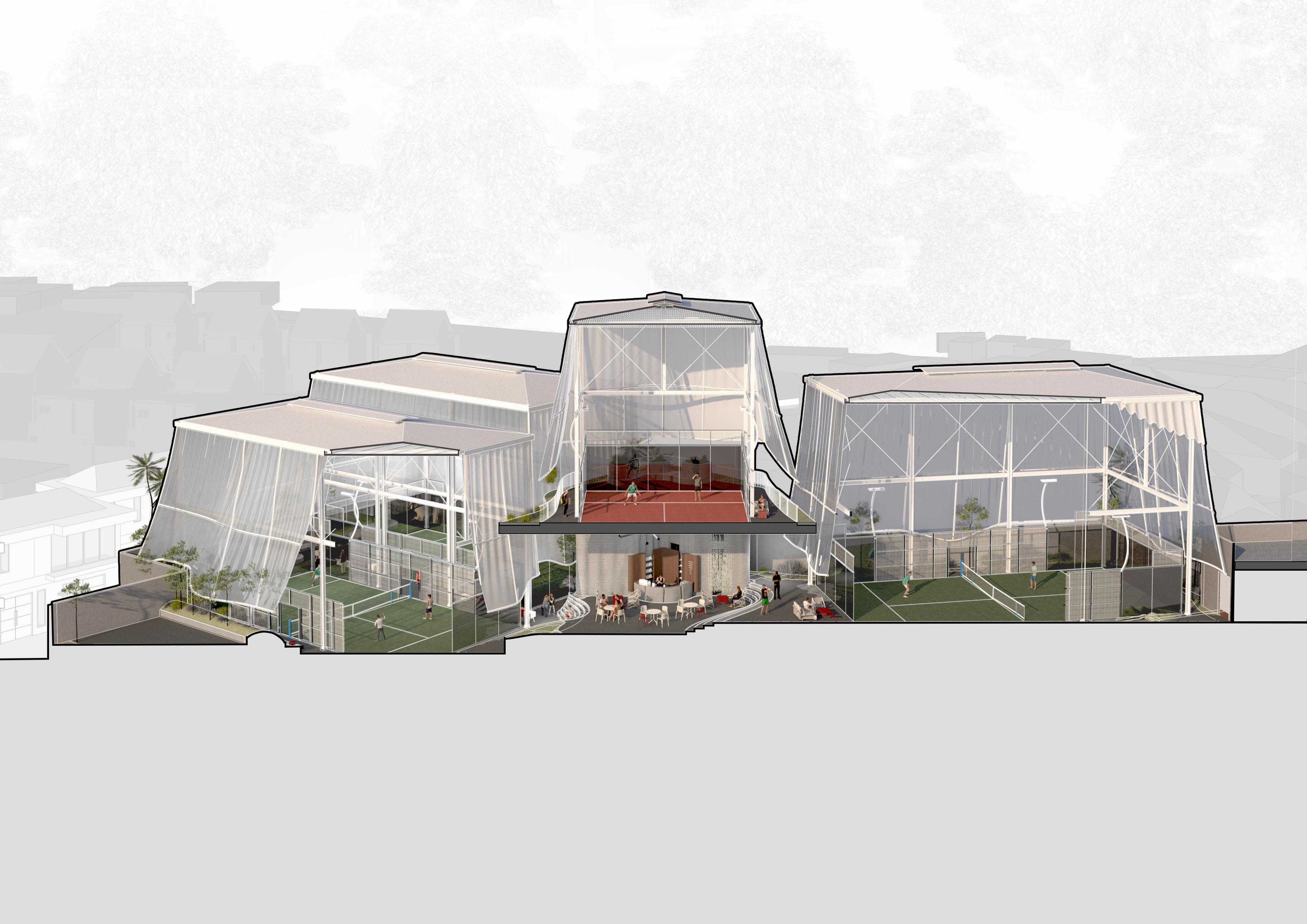
At the center of the site, a cluster of structures is imagined as rocks emerging from the terrain. Utilizing emerging technology, the project represents one of the early explorations of large-scale 3D printing for a commercial building in Indonesia. These masses are defined by textured, curved surfaces that anchor the site and accommodate amenities such as changing rooms, showers, saunas, cold plunge tubs, storage, and service spaces. Between them, a communal plaza with a bar forms the social heart of the complex. Above, a VIP court is positioned on a raised platform, appearing to be supported by the concrete formations beneath.
Four padel courts are arranged around this central composition, following the site’s geometry and natural contours. Each court is wrapped with a lightweight white membrane that allows light and air to remain present at all times. The membranes respond subtly to wind and glow softly like lanterns at night. Shaped through a process of push and pull, they form ripples that expand to shade entrances and seating areas.


(1/7)
Landscape plays a critical role in mediating between the project and its surroundings, creating an experience of playing within a garden. Low-maintenance planting wraps the perimeter, providing privacy without tall boundary walls. Layered landscaping is integrated throughout the site, reinforcing the idea of architecture embedded within the terrain. Circulation paths are paved with permeable materials, with concrete reserved only for the court surfaces to preserve existing site conditions.
People in Charge
Lead Architect
Kelvin Thengono
Design Team
Natashia Angelina T. S. Selwyn KusumaSakshi Raju PawarAdriel FrederickJustina OliviaKevin ChandraImam Eko RahardjoMuammar R. A.